

Water ways, water wise
In an all-year rainfall area where lush vegetation and water sources abound, it is hard to imagine that the southern Cape had seen two major droughts in seven years and that more is to come. Local authorities have heeded the warning signs and continue to address bigger-picture issues in one of the fastest growing regions in the country.
Water management in the Garden Route District is complex. The area incorporates seven municipalities with very diverse rainfall patterns, resources and infrastructure. From all-wet rainforests, oceans and misty lakes south of the Outeniqua mountains to the semi-desert Little Karoo and proper desert Great Karoo, water management requires a multi-faceted approach, interagency participation and open-minded managers.
Fortunately for us, the region’s first major water crisis in 2009/10 activated emergency legislation and funding that kick-started an ongoing, integrated approach that continues to this day.
Garden Route District Municipality (GRDM) Disaster Management head Gerhard Otto says that except for a dry spell in the 1920s when the area was scarcely populated, the sea side of the district hadn’t experienced drought before 2009/10. “Climate change and weather phenomena like El Niño had significant impacts on coastal regions. Two years before we had severe flooding and multiple above-average rainfall events, and here we were dealing with the real threat of whole towns running out of water.
“In addition, population growth has soared since the early 2000s and was expected to continue indefinitely. Not only would more water be consumed, but more bulk infrastructure and storage facilities would be required,” says Gerhard.
That first drought lasted nearly two years and peaked with the Garden Route Dam outside George at 16,9% capacity and the Karatara River above Sedgefield running dry.
The region was declared a disaster area, which triggered national emergency funding for boreholes, laying of additional pipelines, a water reclamation plant in George and desalination plants in Plettenberg Bay, Knysna, Sedgefield and Mossel Bay.
The measures kept the region going until the drought finally lifted, but meteorological reports predicted indefinite cyclical patterns of drought, floods and other weather phenomena.
Since then, the district has been working with all municipalities, relevant government departments, NGOs, landowners and advisers to systematically address potable water supply for the entire district as an ongoing project.
“Disaster Management is about preparing for the worst-case scenario, so we tackle water supply from as many angles as possible and we never let up. Every drop really does count and every action towards conservation matters. It is every citizen’s responsibility to respect water for the scarce resource it is, always, not just when there is a drought.
“Our local municipalities have been excellent in addressing water-related issues – from multi-layered water restrictions and water awareness campaigns to securing national Municipal Infrastructure Grant (MIG) funding for bulk infrastructure development and upgrades.”
The largest municipality, George, has been leading the way in a multi-faceted approach.
Among its greatest recent victories are the raising of the Garden Route Dam spillway and dam wall to secure an additional 25% capacity, and the installation of solar power at water pumping stations to curb effects of loadshedding.
The city has a leaks reduction programme and a rapid response team for pipe bursts. It was the first to amend building regulations for the compulsory installation of rainwater tanks for new developments which reduced usage from 38Kl per day to 25Ml per day within a few years. Only now, more than a decade later, has population growth caught up to the old consumption figures and this time there are sufficient measures in place to address the bigger picture. George Municipality has also successfully petitioned for additional finance from National Treasury to address pressing infrastructure requirements to support massive population growth and related development.
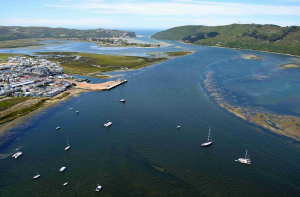
Knysna sources water directly from the Knysna River estuary.
There is concern for towns such as Plettenberg Bay, Knysna and Sedgefield because water is drawn from rivers. If drought sets in, rivers will eventually run too low for water extraction. While emergency wells and desalination are in place, it is not a sustainable long-term solution and some serious money and buy-in from national government might be required to address these fast-growing towns. It is the only area in the district where the building of a dam for the use of both municipalities may be viable, and studies into these possibilities have recently started.
The jury is still out on Mossel Bay whose main water supply is the Wolwedans Dam, which was built in the 1980s for PetroSA’s cooling processes. During the first drought, Mossel Bay was at serious risk of running dry as the refinery drew its usual capacity while the town was under severe water restrictions. At the time, an innovative exchange plan in which purified municipal wastewater was channelled to PetroSA in exchange for dam water for the town, was a major breakthrough.
Since then, the gas deposits off the coast of Mossel Bay has diminished and PetroSA’s output has declined. The refinery’s reduced water consumption is currently giving the local municipality some breathing space, but other options are being explored should it become necessary.
Different rules apply across the mountain in Oudtshoorn where most of its water supply is snow within its catchment area. Just 60km from George, the town is becoming an increasingly popular commuter destination and population figures for the area is growing. The Raubenheimer Dam has seldom dropped below alarming levels, but multiple boreholes in the area is currently still sufficient as a back-up.
Great Karoo towns such as Ladysmith has multiple boreholes equipped with solar powered pumps and supply is expected to be sufficient for the foreseeable future.
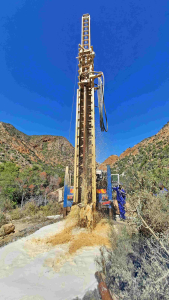
Borehole outside Calitzdorp. Picture by GRDM
GRDM has for the first time explored artesian water, drilled from giant aquifers below the Klein Karoo, to supply water to the area. At 780 metres the four boreholes outside Dysselsdorp are the deepest in sub-Saharan Africa and requires minimal equipment as the depth creates pressure to rise the water above the surface. Water from this source feeds into the Klein Karoo Rural Water Supply Scheme which supplies rural communities towards Calitzdorp, and has the potential to supply other areas with extended pipelines should it become necessary.
Gerhard says the next move is an elaborate cross-municipality water management plan to connect and integrate resources so towns can help each other out during drought. “GRDM has just commissioned a major viability study to explore all options across the entire district, considering relevant legislation, options on public and private land, as well as all types of water supply including surface water, groundwater, rainwater capture, desalination and reuse.
“International minimum humanitarian standards for water supply are 75 litres per person per day. It is the GRDM’s goal to set up alternative water sources to reach the 75-litre target across all municipalities in its jurisdiction, in addition to existing infrastructure. While there will be many hurdles to cross, including legislative and functional implications, I believe it is possible and it will be lifechanging for the long-term sustainability of the Garden Route,” says Gerhard.
The bigger picture
While urban areas have made strides in water conservation, it remains a mere 15% of water consumption in the region. Agriculture uses 67% of water resources and industry make up most of the rest.
Dr Bianca Currie, chief executive of the Garden Route Biosphere Reserve, says that while much can be done to better manage water use on farmland, the largest single threat for long-term water security in the Outeniqua Strategic Water Source Area is the proliferation of water-thirsty invasive alien vegetation in water catchment areas.
“Eradication is expensive, labour intensive and must be ongoing to make a real difference. To be really effective, eradication should be addressed at the source, which in some cases mean high altitude areas that can only be reached by specialised teams,” says Bianca.
The GR Biosphere Reserve has established working groups to identify priority areas within its jurisdiction and priority projects that would ensure maximum water gain for the economies downstream. In the Western Cape, its first focus will be large scale eradication of invasive alien species in the river system that feeds the Garden Route Dam.
“We are also working towards developing an innovative funding model for Strategic Water Source Areas which involves identifying metrics for monitoring and evaluating water quality and quantity gains which can be used by investors to measure outcomes,” says Bianca.
This story, written by ATHANE SCHOLTZ©, first appeared in SOUTH Magazine, Summer 2023.
Photograph tap and Knysna Lagoon by DESMOND SCHOLTZ LEGACY