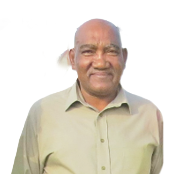
40 years at municipality for Adam Appels
40 years for Adam Appels
Imagine a 20-something housing inspector on a bicycle in the early 1980s, the handlebar of his bike loaded with chains and locks, cycling in a rough neighbourhood on a mission to set tenants out of municipal houses and chain up the doors. Long before the formidable Adam Appels was Senior Manager of the Anti-Land Invasion unit, he was that guy on the bike. In June (2018) he had 40 years’ service in the municipality, most of which was under potentially dangerous circumstances.
“I remember a protest in the 1990s when a black coffin was marched through town bearing my name along with other housing officials, and petrol bombs were thrown at our houses. It got so bad, my family and I was forced to leave town for fear of our safety. When we returned a few days later we weren’t sure if our house was going to be standing.”
Mr Appels was appointed as messenger/cleaner at the George Municipality in 1978 at the age of 17. His manager, the late AB de Swart, recognised his potential and appointed him as a housing inspector five years later.
“When we started, Pierrie Prins and I would cycle to houses where tenants had to be evicted, doors locked and electricity shut down. It was heart wrenching work and people thought I was unfeeling, but it was my job and I was going to do it to the best of my abilities.”
A position as senior housing inspector was offered to both men. “Pierrie declined, he could not bear the emotional burden, but I thought it was an opportunity and I adapted to the circumstances.
“I decided to try and not take my work home, to not let the conflict of the day influence my mood at home. My family was the reason I made it through all the tough times.”
The scariest moment came one day in 1992 when he and two colleagues were cornered at gunpoint in a house in Borchards. “We just ran, jumped out the window and scaled fences until we were out of harm’s way – if we stayed we would have probably been dead anyway, so running was the only option.”
When the Anti-Land Invasion Unit was established, Mr Appels was the obvious choice to head the division and continues to work in the field with his staff. “If my people break down shacks I break down shacks, I don’t think of my myself as higher than them.”
In 2016 Mr Appels had a stroke, and was still in recovery when riots broke out in Thembalethu. He defied medical orders and insisted to be driven to the site to see if his team was doing alright. More recently he and two unit members slept at the Albricks site for two nights to ensure it not be illegally occupied.
“For the first time since the 1990s, the atmosphere feels similarly volatile. I have spent hours talking people down, trying to explain the reasoning behind not allowing people to just occupy land as they please. I have been working with local communities for a long time, and until now those that know me have come up for me during negotiations and protected me – people in Thembalethu call me ‘Apile’ (apple in isiXhosa). It’s all about communication and how you speak to people.”
While he has earned respect, his reputation as an ‘evictionist’ is unescapable. “I would see someone in public and they would confront me for putting their families on the street when they were children.”
His unit also removes homeless people illegally sleeping on private property. “We don’t just chase them away. We see if we can reunite them with their families or get them into a shelter or programme. I’ve often paid out of my own pocket for a bus ticket or a place in a homeless shelter. This is the one aspect of my job where there are sometimes feel-good moments, when someone finds a job, is rehabilitated or goes home. It is great to play a role in drastically changing a life for the better.”
After a predominantly stressful career, Mr Appels thinks it is time to retire soon. “Looking back, I am grateful for the time and energy my former deputy director, Thys de Beer, had invested in me, giving me opportunities and guidance throughout. “Senior administration officer Lecrecia de Wet has been my right hand for 22 years and our Director Protection Services, Steven Erasmus, has shown me what true leadership is. To all the people who have worked with me over the years, thank you so much for your valuable contribution.
“To all staff in the municipality I say: I was an uneducated man when I started here, but I did my best always and was noticed for it. Things don’t just fall in your lap, you must work for it – it took five years for me to get my first promotion, 15 years for the second and nine years until my current position. The municipality is a great place to develop skills, but you must be patient and deserving – you can’t be here six months and start making all kinds of demands. Character and hard work are key.”
*We celebrate Mr Appels’ round number, but he is not the current employee with the most years at the municipality! Sewerage foreman Jusiah Phillips and Protection Services senior clerk Michael Ruiters have both been here 43 years. We hope to have interviews with them in future publications.
This article was written by ATHANE SCHOLTZ for Munindaba, George Municipality’s internal newspaper, in 2018. The paper was started, compiled and edited by Athane as part of her duties as Senior Communications Officer for the municipality. The quarterly 8-pager was printed in colour on newspaper print and distributed to all employees across all divisions.
Athane wrote a series of articles on the municipality’s longest serving staff members for internal channels. If relevantly newsworthy, some stories were turned into press releases.