Doing business on the Garden Route is not for sissies and few companies outlast the complications of seasonality, high transport costs and other factors that have caused thousands of businesses to fail here in the past. South talks to six local businesses that have managed to keep head above water in the Southern Cape for more than 30 years.
By Yolandé Stander and Athane Scholtz
Robberg Group
Despite serious challenges in the fishing industry, the Robberg Group has grown from a fish shop and butchery in Plettenberg Bay’s Main Street in 1979 to a major wholesale fresh and deli food distributor employing more than 70 people. Founding partner and managing director Malcolm Craig shares how the company deals with the ups and downs.
Tell us about your business journey.
I arrived in Plett 1971, never thinking that my fishing hobby would become my profession. I worked for the Ollemans family at the original butchery and fish shop in Main Road, eventually buying it in 1979.
A partnership with the late Peter Dodds allowed us to expand into fishing, processing, retail and wholesale as well as the export of squid and line caught hake.
The by-catch of our boats as well as the excess products allowed us to extend our distribution area to Knysna, George, Mossel Bay and later Port Elizabeth.
A series of challenges affected fish production, how did you overcome these issues?
Permit allocations in 2000, lack of harbour facilities out of Plettenberg Bay and the world financial collapse in 2008, which resulted in a huge decrease in demand on the export market, eventually rendered the industry unviable.
Robberg had by that time built up an amazing network of relationships in the fishing and frozen food industry, and we diversified into distribution of a wider range of food products.
What would you attribute to your on-going success?
My job has always been to look forward to see the bumps in the road. Some people say I am negative but I believe I am a realist and my decisions affect all my staff and their families, so I would rather be aware of the problems ahead of time to better prepare for them. The advantages of looking ahead for the pitfalls are that you can also look ahead to the opportunities. It is that kind of thinking as well as seizing the opportunities at hand that have led to our success so far. Also, having a partner like Blaine Dodds (many times SA and World Hobie champion), whose tenacity as an athlete is reflected in business – we never consider losing or giving up.
You contribute significantly to the local economy and empower locals, what role does this play in standing the test of time?
Success, to me, is that you are only as good as your team. You need to have strong honest relationships with your staff as well as your trading partners. Although many jobs were lost in Plettenberg Bay due to the demise of fishing operations here, Robberg managed to maintain and even increase the number of jobs in our factory. We currently employ more than 70 people full time and take on extra staff over season.
You’ve survived one of the worst recessions this country has seen, what would you say saved you where others failed?
Budget, budget, budget – you cannot spend money you have not made yet, or don’t have in reserve.
www.robberg.co.za
The Potter
Ceramicist Rudi Botha has turned his passion for clay into a flourishing business with a wide range of functional and decorative products. From his eclectic shop on the N2 at Harkerville he supplies retailers and customers worldwide.
How have you managed to make a sustainable living from a craft for nearly 35 years?
Passion helps a lot when you create something but making a living or doing business requires very hard work, long trading hours and reasonable costing.
How has seasonality affected your business and how did you overcome it?
The first three years after I established The Potter in 1981, I opened doors only during the three busy months of summer, and offered pottery classes to locals three times a day during the rest of the year. The classes were popular as there was very little to do other than swimming, fishing, hiking and dodging elephants on your way to Knysna. As Plettenberg Bay grew in size, seasonality became less of an issue. I took orders during busy times and filled them in the quieter times. During the quiet times we delivered personally, and caught up with advertising and produced for season.
When and why did you start supplying other retail stores?
I started wholesaling soon after I opened to soften the seasonal aspect of doing business in a holiday town. Our products and price structure were well received in the marketplace, and we have been open to different ideas and specific requests from clients. This was before faxes, cell phones and social media, and exposure to our products was either by people visiting our shop or craft markets. We had to supply other outlets to grow.
What would you say is the key to your success for so long?
One of the factors was being married to a wonderful friend, Ilza, who carried all the aches and pains of creating and selling. Another aspect was keeping an open mind to create what the public asked for and to keep on learning, as well as hard – very hard – work. Since 1996, The Potter has been open for business seven days a week. When you only have a seasonal market it is no use to complain about bad business if you go fishing or relax on the beach with your potential clients – it was always very tempting to be swept up in the holiday mood.
How important has your location next to the N2 been for business?
After successfully trading in the old Keurboomstrand Post Office for several years from 1981, the new national road was built and it by-passed us. Although The Potter was were already established, the effect on our trade made us realise just how important location and visibility was. That is why in 1996 we chose our current location.
Do you follow trends when you produce your goods or do you stick to a tried and tested formula? How important is following this decision business-wise?
I do look at market trends and constantly renew the product range. Market trends will reflect on your sales and that gives you a clear indication. We, however, also still produce products I started making 35 years ago but sometimes it’s just a matter of evolving them as the market shifts. The bottom line is to look and learn.
www.thepotter.co.za
Pembreys
Few business achievements are as admirable as managing a restaurant on the Garden Route for nearly 40 years. Viv and Peter Vadas, the owners of Pembreys outside Knysna, are legends in a region where the hospitality industry is the first to fail when the going gets tough.
What is the secret of your longevity?
Peter, a qualified chef, and I have been in this business, first at Lake Pleasant Hotel and then Pembreys, since 1977 and we have seen so many restaurants try to copy new or other successful businesses. Rather, serve what you are familiar and comfortable with and soon the business will even out. There is a place for all types of eateries.
You have made it through two recessions when luxuries like dining out were being discarded. How did you survive in the most difficult of times?
It was tough but staying true to ourselves and being confident that we had a niche market that would support us, pulled us through.
How have rising food costs affected your business and how did you counter that?
We cannot deny that profits have decreased significantly, but we can’t just push up our prices every time there is a rise in costs. We just work harder to compensate.
What are the most important business lessons you have learned?
Every customer is important. So often a young person will come in and tell us they remembered eating at Pembreys as a small child. Plus, the locals are more important than tourists because they support us year round and recommend us wherever they go.
To what degree is your business affected by seasonality and how do you overcome it?
Seasonality affects us less now than 30 years ago, when visitors came only between November and January, as season now extends from about October to around May. During the quiet months we pay special attention to guests and do not become complacent.
Do you develop your menu to keep up with trends or have you stuck to a tried and tested formula? How important is this in running a successful restaurant?
We do move with the times and supplies have improved so much on the Garden Route to facilitate this, but our returning customers usually come back for a particular dish so we have to keep the popular dishes as the backbone of the menu. We have become known for making all our own ice creams, pastas, desserts and soup, in fact everything on the premises, and Peter and I will not open the restaurant if we cannot be at work ourselves.
http://pembreys.co.za
Fechters
Established in Knysna in 1936 when indigenous timber production was booming, Fechters furniture manufacturers had to reinvent themselves many times over to survive the significant changes in their industry. Head of operations Morné Smith tells of their journey.
How has Fechters grown into the company it is today?
Established by George Fechter when Knysna was the hub of woodworking and production of fine furniture, the company grew to become known countrywide for quality indigenous solid wood furniture. During a decline in demand for traditional indigenous wood furniture in the early 1990’s, Fechters branched out into the manufacturing of patio furniture. Towards the mid-nineties, we established a good export market for outdoor furniture, which served us well until the onset of the global economic crisis in 2008.
With the rapid demise of the export market, and a local economic recession looming, the business went through a major strategic restructure. Our focus shifted back to the local market and increasing retail sales through our Knysna store. We also diversified our product range further by manufacturing a range of upholstered furniture. This strategy paid off and we have been experiencing constant growth since 2011.
How important is the Fechters brand reputation for producing quality products and how does that relate to surviving in business?
It is very important. As a local manufacturer, we experience fierce competition from imported products and in many cases cannot compete on price. Our niche is to focus on the higher end of the market, where quality is a higher priority than just price. However, we still strive to provide our customers with well-made, value-for-money products.
How important is it to keep up with trends?
The South African furniture market was seen for many years as being of more conservative taste, but with a bigger exposure to overseas trends via the Internet, South African buyers have become more trend and design conscious. We study the overseas trends regularly, and find that they are filtering into the South African market much quicker these days. Our traditional range of furniture does not enjoy the appeal of years ago, and our product ranges are now mostly contemporary.
The local timber industry has taken several knocks over the years, how has this affected business and how did you overcome these challenges?
One of our biggest challenges was the fact that indigenous timber was no longer as freely available on auction as it used to be. There was also a steep increase in price. Our strategy was to reduce our dependency on only local timbers and to work with imported alternatives. Unfortunately the weak rand is not doing us any favours at the moment.
What do you believe have been the key factors to Fechters’ success?
Strategic change in tough economic conditions; understanding the market and adapting to changing trends; a well-established brand that is known for quality products and finally excellent customer and after-sales service have all played a role.
Do you believe it is better to have a specialised range and focus on core products or to be “a Jack of all trades”?
Focus is quite important, and something that we spent a lot of time on. As part of our restructuring, we took a critical look at everything we were producing and made a decision to specialise in the product ranges that were profitable instead of producing anything that came our way.
044 382 7294 www.fechters.co.za
Mungo
Master weaver Stuart Holding and wife Janet have been part of the Garden Route craft revolution since the 1970s and are best known as the creative minds behind Old Nick Village outside Plettenberg Bay. In 1998 Stuart founded the now internationally recognised textile design company Mungo. His daughter Tessa, who heads marketing at Mungo, gives some insight into the company’s success.
How important is top quality, ethical production to business success?
People are increasingly looking for ethically produced products. With a strained economy customers are looking to spend their money better and are tired of inferior quality. Often times they don’t have the choice or it is more convenient to stop at a chain store to purchase homeware, but we have found an increasing awareness and people are looking for quality goods versus cheaper imports.
Mungo has the rare ability to create fabrics from inception of design to final product. What are the benefits of doing this?
We can control the whole process; make sure each step is done to our standards and quality. There is transparency in the production chain, which is important when producing an ethical product. We can also, to some degree, control the costs – although production costs are high in South Africa – as there are no third party buying, selling or importing costs that add to the end price.
Mungo has grown from only a few products made at Old Nick Village to a larger mill, more than 60 different products and retail stores in Plett and Cape Town, as well as international distribution via e-commerce. How has branching out impacted on the company’s success?
Mungo has gained traction around South Africa and there is a definite market in the bigger city centres for what we are producing. We also don’t have to just rely on holiday trade and can have more consistent and sustainable year-round turnover. Mungo is a little off the beaten track in the Garden Route but e-commerce has opened avenues for worldwide export. As a lot of overseas tourists come through the area and visit the shop and museum, we are able to service these clients once they have gone home. It has opened up our market although a challenge is the taxes, duties and shipping costs.
How did you survive the 2008 recession?
Our success is due to hard work, not compromising, believing in what we do and offering a unique product and experience to our customers.
Has product refinement played a role in growing the business?
Stuart Holding has worked mainly from his passion to create textiles. He does not necessarily focus on a specific product or demand, but more on how the cloth will look and feel and what makes it unique. This shines through in our product. Our range started out with quite a classical and European feel, and we are slowly adding a more ethnic branch to it. This may open our export market a little more, although we will not divert far from what has made Mungo what it is.
044 533 1395 www.mungo.co.za
CG Terblanche and Sons
The late Christiaan Gerber Terblanche started his lumber transporting business with one truck in 1959. Fifty-six years later his wife Marie and five sons – Anton, Christo, Marius, Deon and Stephan – continue a legacy that employs more than 130 people.
CG Terblanche and Sons operates as a closed corporation with business including timber harvesting and transport, mixed farming and a general dealer in Elandskraal outside Sedgefield.
What do you think is the key to your on-going success?
We are proud of our good service and all the brothers remain active and visible throughout the business. Two of us still drive trucks, and all of us are hands-on and involved in the nitty gritty of everyday operations. We have gathered around us a good and loyal team of workers, many of whom have been with us for more than 20 years. We work very hard, and expect our employees to do the same.
How has the business survived two recessions and a two-year drought?
We worked very hard at remaining competitive in the market. For instance, we have our own workshop that services 22 trucks weekly and excellent relationships with long-time suppliers of spares and support technicians. We have also invested in specialised machinery to ensure more efficient harvesting. Until 2006 we were also dairy farmers, but we realised we were not large enough to supply sustainably, and the effort that went in did not justify the return per litre. The drought was the final straw – we reduced our stock and moved our business from large-scale dairy to small-scale meat production.
While it looks like the matter will be resolved in the long-term, government instructions to withdraw forestry operations in the Western Cape is having a direct impact on your business. How are you planning to deal with its implications?
As in the past when things got tough, we will look for new opportunities and diversify.
What are the greatest challenges in your business?
Labour issues and related administration is very time-consuming and complicated. There are many safety concerns linked to harvesting trees, transport and farming, and all our workers are extensively trained to ensure minimum risk and injury. The increasing cost of diesel is also always a factor, and filters down to almost every aspect of our business.
How does a family business with so many members involved operate without major fall-outs?
Each of the brothers is assigned a different aspect of the business and assumes full responsibility for his part. We actually get on very well, respect each other, and while we sometimes disagree, we always keep in mind that it is about CG Terblanche and Sons.
What is the most rewarding part of your work?
Being able to work outdoors in beautiful natural surroundings. Knowing that while every day has its challenges, as long as everyone is happy, things will work out for the best.
Caption
CG Terblanche and sons, from left to right Deon, Stephan,
Christo, Marius and Anton. Picture by DESMOND SCHOLTZ LEGACY
This article was envisioned, commissioned, edited and contributed towards editorially by Athane Scholtz© and first appeared in SOUTH Magazine Summer 2015.
Athane was editor of SOUTH Magazine from January 2014-February 2017.



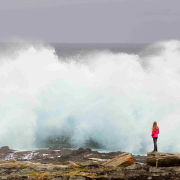
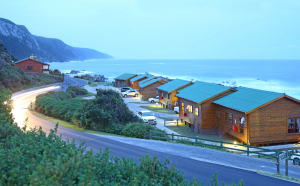 The rest camps offer two very different experiences. Set right on the rocks of raging seas, Storms River is in-your-face wildness with a reputation for living up to its name. Many an unprepared camper has had his tent flattened by wicked winds. Once, a freak wave crushed a sliding door of a holiday flat – several metres above its usual breaking point. While the roaring is ever-present, the log homes scattered along the winding coast are amazingly soundproof and cosy. A wide deck encircles the restaurant, offering unsurpassed views. A tiny man-made beach entertains children and foreigners, the only ones generally willing to brave the chilly sea.
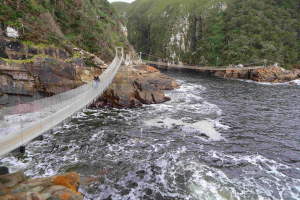 Another world-renowned icon – the dramatic suspension bridge across the 69-metre Storms River mouth that hangs only seven metres above the water – was built in 1969. Exposure to the elements eventually took its toll, and the bridge had to be rebuilt in 2006. Its success prompted the commission of another two suspension structures in 2009, which run along the rocky western cliffs inside the river mouth opening.