Lockdown laughter evolves into hit series
The day after President Cyril Ramaphosa announced Covid-19 lockdown in South Africa, comedian Moses Williams’ grandmother phoned to tell him to shut his mouth – because he talked too much and would contract the ‘Verona-virus’ that way.
Moses thought the conversation so funny he recorded a re-enactment of it on his phone and posted the video on Facebook. The next day it had gone viral, and people wanted more. Three years later (2023), the homemade videos of his impersonations of his beloved Ouma Sarie are legendary and are turning into a television sensation on eTV Extra.
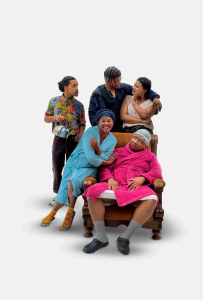
The cast of Ouma Sarie in 2023
The first episode premier, screened on 11 June, attracted an extraordinary 423 274 viewers, 312 883 viewers on the repeat the next week, and 441 624 for the second episode premier. The achievement is even more impressive because it was written, acted and produced by mostly amateurs.
eTV content specialist Marli Schulze said the station anticipated good viewings because of Ouma’s social media track but the show exceeded all expectations. “Ouma Sarie doubled viewing figures for eTV Extra’s 7pm Sunday and 7.30pm Saturday timeslots. We are overjoyed and grateful that we can offer viewers such an excellent, enjoyable comedy. In addition, the show gave training and jobs for several very talented people in George.”
Garden Route Media managing director Marius Wannenburg said the Ouma Sarie series was a culmination of relationships and passion for the film industry. “I met Moses four years ago while he was driving for a courier company, and when we started talking realised his passion for comedy and people. Garden Route Media sponsored him so he could quit his job and pursue his acting and standup career fully, which led to some public performances before Covid-19 stopped everything in its tracks.
“When Ouma Sarie became a social media hit, we started toying with the idea of a series but needed trained crew that could produce TV-quality shows and enough pre-filmed episodes to get a television station onboard,” said Wannenburg.
Instead of sourcing professionals, Garden Route Media trained local film enthusiasts, mostly young people from disadvantaged communities, in all aspects of film production. Meanwhile Moses recruited local actors who had shared the stage with him at school and amateur theatre.
Another local, Actor Viljé Maritz, known for his role as Gys Eloff in M-Net soapie Binnelanders, heard of the Ouma Sarie initiative and put his hand up to direct the show.
Funded by eExtra, the team recorded 39 half-hour episodes for three seasons in ten weeks, an unrelenting pace for even seasoned professionals. “Everyone was so dedicated and passionate, and the result was a quality series that we could proudly present to eTV, who had agreed to a broadcasting licence so ownership of intellectual property of Ouma Sarie remained with Moses’ company KallitLaaitie Productions.
“But really, Moses is the star. He created every story idea, wrote every script, and played Ouma Sarie, all against very tight deadlines. He is truly talented with a bright future ahead of him,” said Wannenburg.
Over a chai latte at a coffee shop in George, Sunday Times talks to Moses Williams, aged 28, about his Karoo roots, high school drama success and seven years of sweat and tears before his breakthrough fame as Ouma Sarie.
“I was raised in Graaff-Reinett by my grandmother Sarie Williams, a small but formidable woman with strong opinions about everything, and no fear of expressing them. In our town, community meetings did not start without her, and local politicians lost their swag when she entered the room. She was a tough lady, took nonsense from nobody and was sharp as a tack. She was raw and real with endless wisdom and loved unconditionally.”
Moses moved to George for high school and took Drama as a school subject because he thought it required the least work. “I was lazy at school and were looking for the easiest subjects to pass, so I was unimpressed when it turned out there was a 50 percent theory requirement, but I was hooked from the start, nonetheless.
“I won major drama competitions and earned distinctions for the subject throughout my school career. There was a part of me that was shy and withdrawn, but my love to entertain overtook my inhibitions. I loved to make people laugh and couldn’t imagine doing anything else.
“I had been riding the rollercoaster of high school drama success without considering the future much, but two weeks before final matric exams I realised I had no plan. Yes, I had won all those awards, but how was I going to make a living from it?”
In an attempt to launch an acting career before the support structures were gone, Williams started a drama group in the middle of matric finals and was a little put off that his friends were more focused on matric exams and finding work. “Needless to say the drama group had limited success and I too went looking for work that would pay the bills between gigs. I did all kinds of jobs through the years, but I was best where I could interact with people – such as a petrol attendant and courier driver.”
He eventually established himself as a popular local master of ceremonies, but his heart was with comedy, especially standup. “Trevor Noah and Kevin Hart are my heroes because they tell their own stories and can make people laugh about the realities of life.
“I worked very hard, put in the hours, and travelled all over but never made that major breakthrough, and then Covid changed everything.
“That first Ouma Sarie post was instinctive and just a way to lift people’s spirits after such dire news. The overwhelming response inspired me to delve into the archives of my memories of the funny things my grandmother had said and done, and each clip was a re-enactment from a real-life situation.
“People loved it because it was relatable and authentic – we all know an aunty or granny like Ouma Sarie and she speaks the truth on behalf of us all.”
Williams said the real Ouma Sarie was initially unimpressed by his copying of her. “She told me in true Ouma Sarie style what she thought of my little videos and had rough words about the way in which I was throwing her name and reputation about.
“But, also in true Ouma Sarie-style, she knew a good opportunity when she saw it. When I told her of the videos’ success and that it was my boosting my career and income, she was quick to demand her cut, which I gladly ‘paid’. It was wonderful to give back to someone who had made sacrifices for me, protected me and so richly contributed to my life.”
Ouma Sarie died of natural causes in November 2021, aged 79. “She would have been really tickled by being on national television and would have loved to see the live performances on stage such as ‘her’ recent appearance at the Klein Karoo Kunstefees (Oudtshoorn 2023).
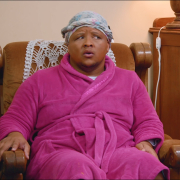
“Now, when I write about a scenario, I just go back in time and picture her in her pink gown, telling the world what to say and do. The series also involves other relatable characters such as the neighbourhood gossip lady, the new generation dolled up granddaughter always busy on her cellphone and the guy living in the backyard wendy house who never pays rent,” said Williams.
These days Moses seldom goes anywhere without being recognised and he takes great pride in being called ‘Ouma Sarie’. “I carry her legacy and hope to inspire a new generation to make the most of their circumstances.”
After three months of non-stop shooting, Moses is looking forward to exploring his ‘MC Moses’ comedic character that had been taking a backseat. “I have some great ideas and maybe even a new character to introduce.”
He is also looking forward to spending time with his partner Simone Cloete and sons Khilermo Cloete, six, and Emjay Williams, four.
But Ouma Sarie is unlikely to stay under the covers for long with preproduction for series 4 to 7 already on the cards, and a ‘Ouma Sarie on-the-go’ podcast in which ‘she’ interviews celebrities and interesting people while travelling around the country between gigs.
“One of the best things that have come out of the Ouma Sarie experience is the response from Afrikaans speaking people across all races. This opinionated lady is relatable to everyone and she is making people laugh together over this unique country and all its complications. To me, that is wonderful,” said Williams.
Written by ATHANE SCHOLTZ, this article was first published in Sunday Times newspaper on 2 July 2026.
Photographs by Garden Route Media.