
What is a wo(man)’s job these days?
George Municipality is celebrating some of the increasing number of female municipal staff doing work previously considered a man’s job.
Superpower: bringing light to the people every day – Ida Lucas
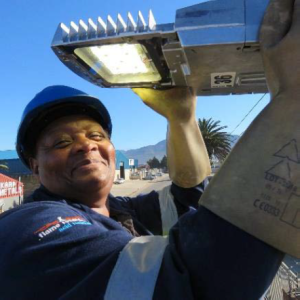
Contrary to popular belief, Ida Lucas does not change light bulbs for a living.
Fixing a streetlight means changing a lamp head – which can weigh more than two pockets of potatoes – while dangling four storeys high over a busy street in the bucket of a cherry picker truck, while the electricity is live.
A perfect job for a woman, really, with having to multitask, problem-solve and be super safe all at the same time. But until 2005 there were no women on the George Municipality streetlight team. Notwithstanding the general perception that this was a man’s job, it may have had something to do with the fact that certain aspects of this particular job require serious strength.
But this 47-year-old grandma is the last to let heavy work stand in the way of getting things done. She has been known to hammer a rusted bolt into submission for 15 minutes until it finally gave way, and has devised a system with an assistant to handle the very old streetlamps which weigh about 20kg. “We shimmy the lamp head onto our shoulders and balance it while we secure the wires – so the cables don’t slide down into pole – then lower the cherry picker slowly to put the old lamp head down and take a new one up. Thankfully we are starting to replace those old lamp heads with LEDs, which is much lighter, smaller and of course more energy efficient.
“Sometimes there are parts of my job that need a man’s physical strength, and if that is the case, I am not afraid to ask. They sometimes enjoy chirping us then with ‘you want to do a man’s job but you are not strong enough’, but so what? There are many more things I can do that most men can’t do, so it’s the same.”
This is not a job for people who have issues with heights. Streetlights in George are on average about 11 metres (nearly four storeys) high, but can be as high 30 metres including the high mast lights used in informal settlements.
“Electricity is deadly and I am super-focussed on safety while I work. I leave my cell phone in the truck when I am working up there so there are no distractions. My family knows, if I don’t answer the phone it is because I am somewhere working with something dangerous and will phone back when I can.”
After a hard day’s work, Ida goes home to New Dawn Park where seven dependents including a disabled child, elderly parent and grandchildren await. “My family is impressed and proud of what I do, and while I earn the money to look after them, I also do this work for me.
“I love my job very much. It is nice to work outside and bring light to people wherever I go. Mostly I am so busy I don’t really stop to look around and take in the view when I am up there in the cherry picker, but I should: it’s not everyone who gets a bird’s view of such a beautiful town every day.”
Cable girl – Nontsikelelo Jaji
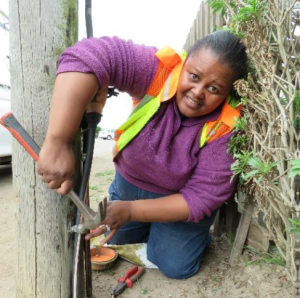 The day Nontsikelelo Jaji, 38, climbed a ladder to fix the cable of a streetlight outside her father’s house in Lawaaikamp in George, he for the first time fully grasped what his daughter did for a living. “He kept saying ‘ek kan nie glo nie’ (I can’t believe). He came out of his house and watched everything I did and kept shaking his head…but in a good way. When he realised I was in charge of a bakkie load of men, he was speechless. When we were done, he said to me: ‘my kind, ek is trots’ (my child I am proud). That was a good day.”
Nontsikelelo is a special worksman dealing with streetlight cables, which includes fixing cable faults, reinstalling stolen cables, replanting street poles that fell over, putting up temporary electricity boxes for events, and more – she is literally the cable girl.
She is also where many youngsters start as casuals, which means a bakkie filled with mostly young men. “When I start with new guys, I sit them down and say: ‘I know in our culture men think they don’t have to listen to women, but this is work. Here you must listen to me, because electricity is very dangerous and I know what I am doing.’ I also promise them that by the time their contract is finished they will have learned something. They won’t just dig and drag cables around. I will teach them the basics of electricity, how to be safe and what to do if they want to pursue this as a career.
“I may be the only woman among a team of men, but I do my part. I also dig holes in hard soil and pull heavy cables – but I also share my skills with them so there will be a next generation of good, safe electrical technicians out there some day.”
Nontsikelelo was a street cleaner and waitress at Fancourt banqueting before she landed an electrical assistant job at the George Municipality in 2007 and was appointed to her current position in 2015. “When the opportunity to apply for a vacant electrical position came along it was one of the men, electrician Thomas ‘Rasta’ Scheepers, who encouraged me to go give it a try. He said if I didn’t try how would I know if it wasn’t for me – ‘you will like it’, he said. Rasta was right, about all of it.
“Like any job, the work isn’t all great, all the time. It can be very hard when people are disrespectful or even hateful, but I have learnt to not let other people’s ill-informed opinions determine how I think of myself.”
She lives is Zone 1, Thembalethu with her school teacher husband, Mava, and 16-year-old daughter, Sikelelo. “My late mother, Deborah, used to be especially concerned for my safety, but I assured her that safety always came first and she shouldn’t be afraid, because I was not.
“I want women to know they have it inside themselves to change their circumstances. Don’t underestimate yourself. Ask questions about things that interest you, even if you know nothing about it – I learnt from scratch, but I did it. There doesn’t have to be men’s work and women’s work, it is for everyone.”
I always wanted to be a truck driver – Annaline April
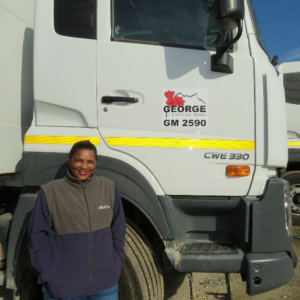 Even as a little girl Annaline April wanted to be a truck driver. “I remember seeing a small man getting out of a big truck and thinking if such a little man can drive such an enormous thing so can I.” It would be decades before her dream would be fulfilled but today the 44-year-old mom from Blanco drives a high-tech refuse compactor truck for the George Municipality and has a Code 10 Driver’s License she paid for herself. Annaline taught herself to drive. During school holidays working on the farms outside Great Brak River where she grew up, she would ‘steal with her eyes’, figuring out for herself how the gears and pedals worked. “One day, the farmer jumped out of the moving bakkie to run after an animal and shouted ‘Annaline take over’, assuming I knew how to drive – so I scooted over and drove in first and second gear all the way,” she laughs. After matric she followed a boyfriend to George and got a security job at the municipal rubbish tip in 2004. “If any type of vehicle stood idle, I would jump in and practice driving in secret. I eventually got my Code 8 and 10 drivers’ licenses like that – I saved a bit of my salary each month to pay for the licence and eventually a car of my own.” The Code 10 turned out to be the ticket to advancement as her convenient location at the dumpsite meant she could help move large vehicles on site, pick up and drop off trucks for other drivers, and do many a menial task for which a decent size truck is the logical answer.
Her job at the tip connected her with the municipality’s only two women refuse truck drivers, who not only became as close as sisters, but also told her of a post becoming available for a tipper truck driver in their department. “My husband Abraham is a long-distance truck driver, so when I applied for the tipper driver job, my daughters, Shannen, 25, and Samantha, 19, wanted to know if I wanted to be like their father. I said it was not about that: this was my opportunity to better myself and I was going to take it. “I never really considered driving a truck a man’s job, just one in which there were few women. Some men see women doing jobs that were traditionally men’s and think we are a threat. I say to them: ‘I am not standing in your way, but I am also not standing back for an opportunity we deserve equally.’ “When people hear I am a truck driver, they are interested and amazed. It feels great when other women say ‘wow, it shows you, we (women) can do this also.” Annaline considers her regular route in Wilderness, Kleinkrantz and The Dunes the best, with friendly people everywhere who wave and smile when they recognise her. “We have stolen each other’s hearts.” There isn’t really anything she doesn’t like about her job, maybe just waiting for another truck to finish its rounds when hers is broken, which may be after 4pm. On nights like those she will most likely get home after 11pm. “Your mind must be strong to deal with frustrations, harsh weather and long hours. I arrive home tired to the bone, but happy because I have served today.”
Electricity police – Leoni Baartman
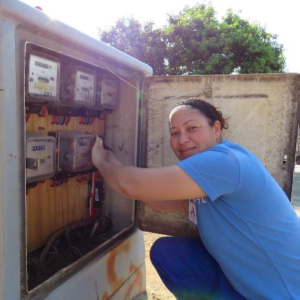 Leoni Baartman may just have one of the most dangerous jobs in the municipality.
A day in the life of this 35-year-old mom from Pacaltsdorp will probably include open and live electricity cables, hostile people, aggressive dogs and heartbreak. “Nobody wants to do my job – until very recently I was the only one in the municipality to do it. There is almost always conflict, but I feel this is important, because it is life and death. If I don’t do it, how many people may die?”
Leonie is a specialised electrician dealing with electricity metres, and when people don’t pay their electricity or steal someone else’s, she is the one to shut you down and write you the R4100-plus fine. If you lay your own power lines, bury them underground and connect them illegally, Leonie will safely disconnect and rip them out. She is literally the electricity police.
But unlike the ‘boys in blue’, Leoni does not carry a gun, though she probably should. She is, however, accompanied by municipal Law Enforcement officers most of the time, because people are not nice when you take away their warmth and their light. “I am a mom and find it so hard to cut electricity when there are kids to be fed, washed and warmed up, but it would be so much worse if there is a fire caused by illegal connections. I have seen animals killed by electricity, it is terrible – so very, very dangerous.”
She started working as an electrical assistant at the municipality in 2006 and did all the tough work that comes with that job, including digging with an axe and spade. “I decided to empower myself. I saw there was a need for truck drivers and got my Code 10 driver’s license and, when the opportunity for an electrical learnership became available, I signed up.” There was also specialised training for working with electricity meters, which she completed, and for the last four years she has been working as a specialist electrician with the intricacies of meters.
“In municipalities there are more and more female electricians, and it doesn’t really feel like a men-only kind of job anymore, but I think that what I do falls in another category. Men and women find this particular job hard – not just because of the conflict, and the danger of live electricity, but also because of the direct effect this job has on people’s lives. I don’t think people realise how dangerous electricity is – we try to explain to them why they cannot make illegal connections, but they are desperate and take the chance.
“This job will probably get to most people, but it has real purpose. Roaming pets and playing children are the most likely to come across illegal connections, so I think of them when I issue fines and cut electricity.”
Her husband, André, an inspector with the NSPCA who himself has encountered countless conflict situations linked to animal abuse, understands her motivations. “We have a ten-month-old boy, Athan, for whom we want a better tomorrow. In some small way I think our jobs contribute towards making the world better.”
Not afraid of heights and other challenges – Loyanda August
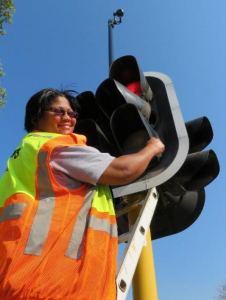 The back of Loyanda August’s work bakkie is probably the best indicator that installing and fixing traffic lights is much more intricate than fiddling with wires and replacing light bulbs.
In addition to traffic signs, ladders, wires, tools and gadgets, you will also find hardcore pickets and spades – because, if it calls for it, she digs holes, replants poles and does whatever in the past may have been considered male territory.
Loyanda, 33, is a special worksman: traffic lights, which means she has expert training and experience to deal with all aspects of installing and fixing traffic lights. This includes specialist electronic programming, electrics, mechanics, hard labour and sometimes just plain old common sense. As traffic lights are part of road systems, she also works closely with civil engineering contractors building and upgrading roads in the city.
“I am very proud that complaints in my division are usually fixed the same day, mostly within minutes or hours, unless a part needs to be acquired or something more complicated is required. When I travel to other municipalities, I often see traffic lights that have been off for weeks or months – it reminds me that, even with all the things that can go wrong, we are doing a very good job in our municipality.”
Loyanda studied at the Institute of Business Management after matric, started as a casual worker at the municipality straight after, and landed a permanent appointment as electrical assistant in 2005.
When opportunity for an electrical learnership became available she signed up. “I am very proud to have come this far but want to advance myself more – the next step for me is becoming a technician.
“When people see it is a woman up the ladder fixing a traffic light, there is almost always a response. People driving by hoot and wave. Some men get a bit cheeky and shout stuff out the window but generally it is all in good spirit. Passers-by stop and look, often asking how a woman got such a job. They are even more amused when they realise we are an all-woman team (my assistant, Noloyiso Baleni, is also a woman) and there are no men in sight to do the ‘hard’ work. When we tell them we do our own ‘dirty work’, they are very impressed.
“We are a new generation where jobs are not necessarily meant to be for a woman or a man. We can learn from each other. Men have been doing these jobs forever, their experience can help us. I am willing to learn, work hard and help where I can.
“Any work has its challenges. In this one, for instance, you can’t be afraid of heights,” she laughs. “You must stand your man if you want to do a man’s job, but if you do your work well, people realise you are an asset, not a burden.”
When the single mom goes home to Pacaltsdorp with her five-year-old son Amin, she leaves work behind and do others things she loves – like cooking. “Everything should not be about work, and building an independent, positive life on your own terms is important. I want to tell all people: set yourself goals and have a motto for your life. Don’t get stuck in the present: look beyond today and work towards bettering yourself always. It can be done.”
My daughters want to be truck drivers too – Mirriam Zimemo
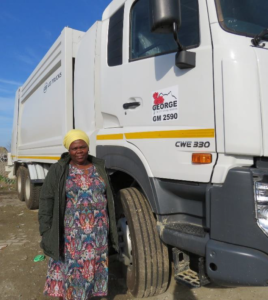 Mirriam Zimemo, 49, knows all about in-your-face gender discrimination. Although she has had her code 10 drivers’ license since 2011, and had applied for the position before, it wasn’t until 2016 she could move from cleaning streets to driving down streets in a ten-ton tipper truck.
Today she has even more responsibility, driving a high-tech compactor refuse truck with an all-men collection team – a fact her family is very proud of. “My people know where I have come from, and how difficult it was to get this far. It is still not an easy job, but I like it very much.
“The first time I went for an interview for the tipper truck job there were just men behind the table. They wanted to know why I thought I could have such a job. When I tried to answer, they said I thought I knew everything and should just go.
“It is better now, but when I started working on the tipper truck the men did not accept women doing any job that only men did in the past. They would deliberately slow collections down to make me late and went out of their way to be difficult with the smallest of tasks.
“It was tough, and I sometimes thought of looking for other work, but I also felt there was no real other choice for me because my husband, Nicolas, was retired and at the time I was the breadwinner.
“In municipal departments where only men used to work, there are now many opportunities for women to step in. It is not for everyone, because it often means physical work in smelly places, long hours and the realities of working among a group of hard men. But I think the type of men who work with me now are generally better men, we work well as a team and, we get things done.
Mirriam and Nicolas live in Thembalethu Zone 3 with their son Victor, 29, who works in security and two daughters Beauty, 25, and Akhona, 22. The girls want to get their Code 10 driver’s licenses too. “It is a great privilege for me that they think it is worth following in my footsteps.”
Sometimes people call me ‘sir’ – Tersia Stoffels
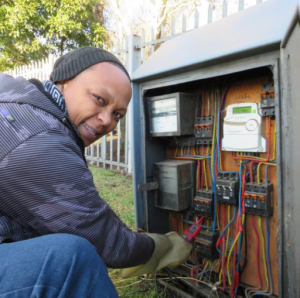 Work overalls are not the most flattering attire any day of the week, but if you are a woman, it is tough the first few times someone at first glance calls you ‘sir.’
“Though I understood that in full gear, doing hard labour like any other man in the team, I really didn’t look very feminine, it still stung a bit. After twelve years I am used to it and have accepted it comes with the territory.
“People are always very apologetic when they realise I am a woman and I just laugh it off now. I get the job done, which is what is important,” says Tersia Stoffels, the 34-year-old mom from Pacaltsdorp.
Tersia is an electrical assistant working with the municipality’s electricians on low voltage lines, but has experience across most areas within the municipal electrical sphere including high voltage, streetlights and the night-time standby teams.
“The municipality was my first proper job after I had my daughter, Tammy Lee, who is now 16. When I started here in 2006, there were only four other women here, and they were relatively new too.
“The men were initially sceptical and quite verbal about the fact that we were coming in and taking ‘their’ jobs. But I think they were secretly fascinated and maybe even excited to have some women in the place. The atmosphere is probably very different these days, with many women working here, in comparison to what it must have been like before the 2000s.
“The electrician I am usually assigned, Charles Campher, and I get along very well and I have learnt so much from him. I hope there is an opportunity for me to get onto a learnership programme so I can advance myself.
“The best thing about this job is being among happy people who makes you laugh. Early in the morning, when everybody gets ready for the day, there is this lively vibe and everyone is positive. This can be a very demanding, physical job sometimes, but we are not alone, and the camaraderie is very special.”
Not a man’s job or a woman’s job, it is my job – Belinda Jantjies
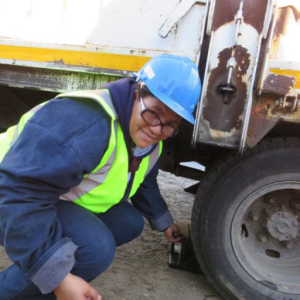 “The men always say ‘50/50’, which means if women are going to work here, they must do all the work the same as the men. If a hole must be two metres deep, the man does a metre and I do the other metre. That’s fine by me, I really don’t mind the physical work.”
Belinda Jantjies is an electrical assistant in New Works at the George Municipality, the teams responsible for setting up new transformers and infrastructure and laying new lines. There are all kinds of big and little things that come with the job, but Belinda’s job really comes down to safety – from putting down danger cones and wheel stoppers behind truck wheels to balancing trucks on uneven surfaces and keeping pedestrians clear of work sites.
“Two days in a row are seldom the same, and the job takes us to places where few people go. The other day we found ourselves up in the mountains surrounded by plantations, the next day we were planting polls in an informal area. Unless the weather is really miserable, it is great working outdoors – our days are jam-packed with all kinds of work all over the place, but you are also free, it’s just you and the job at hand.”
At the age of 53, any kind of physical work takes its toll, but Belinda is not just any woman. Before she started at the George Municipality as electrical assistant in 2007, she was working on construction sites – as labour, which included laying paving, and later as supervisor responsible for health and safety. “I realised there was a need for people who could operate a cherry picker truck, so I did a course in that to empower myself, which ultimately helped me get the job at the municipality.”
But she is not all brick and mortar. This mom of three and grandma of four from Protea Park also has an NQ4 health care qualification and was a home-based carer for three years. “Being strong is not just about physical work, it is about being strong in your mind and with your emotions.
“I want to tell women that they can work in a man’s world. The job may not be what you thought it was going to be like, but you can do it. Don’t let men humiliate you, they are not necessarily better at a type of job because they are men. I packed paving as good as any man when that was required – to me it was not a man’s job or a woman’s job, it was my job, and I was going to do it the best way I could.”
These articles were conceptualised and written by Athane Scholtz© in 2018 to celebrate Women’s Month as part of her duties as Senior Communication Officer for the George Municipality. She conducted all interviews, took all the photographs and wrote all the stories. The stories were issued as press releases that were well-covered by local and regional print media at the time. The stories were also published in the municipality’s internal newsletter, for which Athane was the editor, and posted on the municipality’s website and other platforms.
(Photos not original quality, originals not available)